


AI TRiSM Explained: How to Manage Trust, Risk & Security in an AI System

  • Home
  • AI TRiSM Explained: How to Manage Trust, Risk & Security in an AI System
AI TRiSM Explained: How to Manage Trust, Risk & Security in an AI System

Person at desk using a computer with charts, overlaid with text about AI TRISM: “Building Trust, Managing Risk, Securing the Future” on a red background.


AI TRiSM: Understanding the Right Way to Manage AI Tools and Security

Artificial intelligence has quickly moved from being a futuristic concept to a critical business tool. Today, nearly two-thirds of organisations are using generative AI for tasks like customer service chatbots or advanced data analytics. While AI offers many benefits, it also brings new risks and security challenges that cannot be ignored. To address this, AI TRiSM, a comprehensive framework for AI Trust, Risk, and Security Management, becomes essential. It helps organisations deploy AI solutions safely and sustainably, balancing innovation with risk mitigation and regulatory compliance.


What is AI TRiSM?

AI TRiSM (Artificial Intelligence Trust, Risk, and Security Management) is a comprehensive framework developed by Gartner that ensures the governance, trustworthiness, fairness, reliability, robustness, efficacy, and data protection of AI models.

This framework helps organisations identify, monitor, and mitigate potential risks associated with AI technology implementation, while ensuring compliance with relevant regulations and data privacy laws.

AI TRiSM takes a structured approach to managing AI by focusing on three key areas.

  • Trust: building confidence that AI systems perform reliably and make ethical decisions.
  • Risk: identifying potential problems before they happen and finding ways to reduce those risks.
  • Security Management: protecting both data and AI systems from unauthorised access or tampering.

Together, these components help organisations use AI safely and responsibly.


Why does AI TRiSM matter?

Businesses that put strong AI TRiSM frameworks in place see real benefits across their operations, security, and compliance efforts. In today’s AI-driven world, here’s why it’s so important:

  • Stronger model security: Protect AI models from tampering and unauthorized access by using encryption, multi-factor authentication, and secure storage.
  • Risk prevention: Spot potential issues early and take steps to avoid them, helping businesses stay in control and avoid disruptions.
  • Regulatory compliance: Ensure AI systems follow industry rules and data privacy laws, keeping your business aligned with legal requirements when handling sensitive information.
  • Better decision-making: With AI TRiSM, businesses can expect more accurate AI outputs that lead to smarter choices.
  • Data privacy protection: Implement strong privacy safeguards to keep sensitive data safe—especially crucial in industries like healthcare, where patient confidentiality is a top priority.

Key Components of the AI TRiSM Framework.

The AI TRiSM framework stands on three essential pillars that work together to create a strong and trustworthy foundation for AI governance. Each pillar focuses on a key area, from building stakeholder confidence to protecting against new and evolving risks.

1. Trust

Trust is the cornerstone of successfully adopting and deploying AI in any organisation. This pillar aims to make AI systems transparent and understandable, giving everyone confidence through clear decision guidelines and open communication about how AI systems operate.

Building trust involves:

  • Strong governance frameworks that ensure AI performs reliably
  • Clear audit trails documenting AI decisions and their outcomes
  • Transparent documentation outlining what AI systems can—and can’t—do.

2. Risk

Managing risk means proactively identifying and addressing potential AI challenges before they impact operations. This pillar focuses on the many challenges AI presents, including biases in data, regulatory compliance, and technical vulnerabilities.

Effective risk management requires:

  • Assessing and mitigating biases in training data and AI outputs
  • Ensuring AI systems comply with relevant laws and standards

3. Security

Security acts as a protective shield, safeguarding AI systems from threats both inside and outside the organisation. This pillar is about putting strong defences in place throughout the AI lifecycle.

Key security measures include:

  • Protecting training data and AI model details
  • Securing how models are deployed and updated
  • Controlling access with strong authentication
  • Continuously monitoring for unusual activities or breaches

Key Features of AI TRiSM

According to Gartner, these are the key features that form the foundation of an effective AI TRiSM platform:

  • AI Catalogue: A centralised inventory of all AI assets in use- including models, agents, and applications. This covers everything from built-in AI in third-party tools to custom-built models, bring-your-own AI setups, and RAG systems.
  • AI Data Mapping: A way to track and map the data that’s powering your AI systems — whether it’s used for training, fine-tuning, or feeding contextual information in real-time.
  • Continuous Assurances and Evaluation: Ongoing checks to ensure your AI systems are performing reliably and meeting key expectations around safety and security. These evaluations happen at multiple stages – including pre-deployment, post-deployment.
  • Runtime Inspection and Enforcement: Live monitoring includes inspecting inputs, outputs, and interactions for any violations of policy or unexpected activity. Issues can be flagged, automatically fixed, blocked, or escalated to security teams for investigation.

Four Layers of AI TRiSM

AI TRiSM is built on four key layers, with a fifth foundational layer made up of traditional tech tools like network, endpoint, and cloud security solutions.
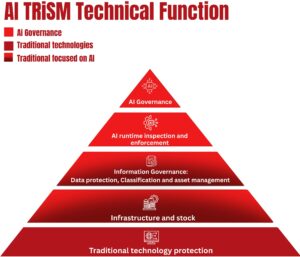
iagram of the AI TRiSM Technical Function pyramid, illustrating five layers: AI Governance, AI runtime inspection, Information Governance, Infrastructure, and Traditional technology protection, with icons and color-coded sections representing AI and traditional tech roles

1) AI Governance

This layer focuses on managing how AI is developed and used across the organisation. It involves multiple teams – from legal to engineering – and ensures that AI is:

  • Fair, transparent, and ethical (Responsible AI)
  • Secure and used as intended (Protected AI)
  • Built on trustworthy, well-managed data (AI-ready data)

It also supports audits, traceability, and compliance with frameworks like NIST AI RMF, ISO 42001, and the EU AI Act.

2) AI Runtime Inspection & Enforcement

This layer monitors AI systems in real time, whether it’s a model, app, or agent, to:

  • Detect unusual behaviours or policy violations.
  • Auto-block or remediate risky actions.
  • Protect against misuse, prompt injection, or data leakage.

3) Information Governance

This ensures that AI only accesses the right data, at the right time, with the right permissions. It includes:

  • Data classification & lifecycle management.
  • Purpose-based access controls (PBAC).
  • Avoiding oversharing on platforms like Microsoft 365 or Google Workspace.

4) Infrastructure & Stack

The foundation layer includes the hardware, software, and deployment environments that run AI workloads. It focuses on:

  • Protecting sensitive workloads (e.g., with confidential computing)
  • Managing API keys, model access, and development tools.

How the Four Layers Work Together:

  • The top two layers – AI governance and runtime solutions – are now coming together to create a new market segment. This is becoming more important as companies look for better ways to manage the risks that come with using AI.
  • Even with this shift, this new combined layer (governance + runtime inspection) will still rely on enterprise tools found in the bottom two layers, which focus on protecting AI systems and the data they use

Conclusion

Artificial Intelligence is reshaping industries, but its real value comes only when it is trusted, secure, and responsibly governed. AI TRiSM provides the guardrails businesses need to strike the right balance between innovation and risk management.

By integrating AI TRiSM into your security and governance strategy, you not only safeguard sensitive data and ensure compliance but also build the foundation for sustainable, future-ready innovation.

The message is clear: AI without trust is a liability. AI with TRiSM is a long-term asset.

References

The content of this blog has been informed by insights and definitions from leading industry sources, including Gartner, IBM, Splunk, and Proofpoint, along with additional perspectives from other industry analyses and our own understanding.

Leave a Reply

Your email address will not be published. Required fields are marked *